



Jordan has warned that the Middle East is at the edge of an “abyss”, as diplomatic activity intensifies to prevent the Israel-Hamas war from spiralling into a regional conflict.
King Abdullah of Jordan delivered his warning — together with a call for humanitarian assistance to the Gaza Strip and a refusal to take in Palestinian refugees — ahead of a summit with US president Joe Biden on Wednesday.
“The whole region is on the brink of falling into the abyss,” the king told a press conference in Berlin with Chancellor Olaf Scholz, in comments translated by the German government. “The threat that this conflict spreads is real; the costs are too high for everyone.”
On a trip to Tel Aviv later in the day, Scholz said: “We have to stop a regional conflagration,” adding that he was talking to the leaders of both Israel and Egypt about getting aid into Gaza.
He added: “No actor should think it a good idea to intervene in this conflict from outside. It would be a grave, unforgivable mistake. In the past few days we have passed on this message through the most diverse channels to those it is directed at.”
But Israel accused Iran of “escalating the situation” in its northern border region with Lebanon, a day after Tehran warned that the Islamist militants it backs could resort to “pre-emptive” attacks.
Wednesday’s summit in Amman will also include Egyptian president Abdel Fattah al-Sisi and Mahmoud Abbas, the president of the Palestinian Authority, while Biden will first travel to Israel to show solidarity and try to influence the conduct of the war.
In a further signal of international concern, UN secretary-general António Guterres is also due to travel to Egypt on Wednesday, a senior UN official said.
King Abdullah said admitting refugees was a “red line” for Jordan and for Egypt, which borders the Gaza Strip, the Hamas-controlled territory Israel is bombarding ahead of a widely expected ground invasion in response to the militant group’s deadly attack this month.
“No refugees into Jordan and no refugees into Egypt either,” the king added. “That’s a situation that must be dealt with inside Gaza and the West Bank and the burden shouldn’t be borne on others’ shoulders.”
But as tensions rose on the Israel-Lebanon border as well as in Gaza and on the West Bank, exchanges of fire intensified between the Israel Defense Forces and Tehran’s ally Hizbollah, the south Lebanon-based militia.
The IDF said it would hold “the sovereign state of Lebanon . . . responsible for the terrorism from within its territory.” Four people were killed in shelling on southern Lebanon, according to the Lebanese Red Cross, and Hizbollah later said that four of its fighters had been killed.
An IDF spokesman warned Hizbollah and Lebanon itself “to look very carefully, how we are dismantling Hamas in the Gaza Strip leader by leader, terrorist by terrorist and indeed infrastructure by infrastructure. We will exert a serious price.”
The US has already deployed two aircraft carrier strike groups to the region to deter Iran and Hizbollah and the Pentagon said on Tuesday it had put a further 2,000 troops on a “prepare to deploy order”.
US secretary of state Antony Blinken has also said that, at Washington’s request, the US and Israel have agreed to “develop a plan” to get aid to Gaza residents and potentially create “areas to help keep civilians out of harm’s way”.
As negotiations continue ahead of Biden’s trip, Israel says that any “safe zones” to which humanitarian aid can be provided will have to be in the south of the enclave.
The US, which estimates that 500 to 600 of its nationals are trapped in the enclave, is also seeking an exit for third-country passport holders out of Gaza.

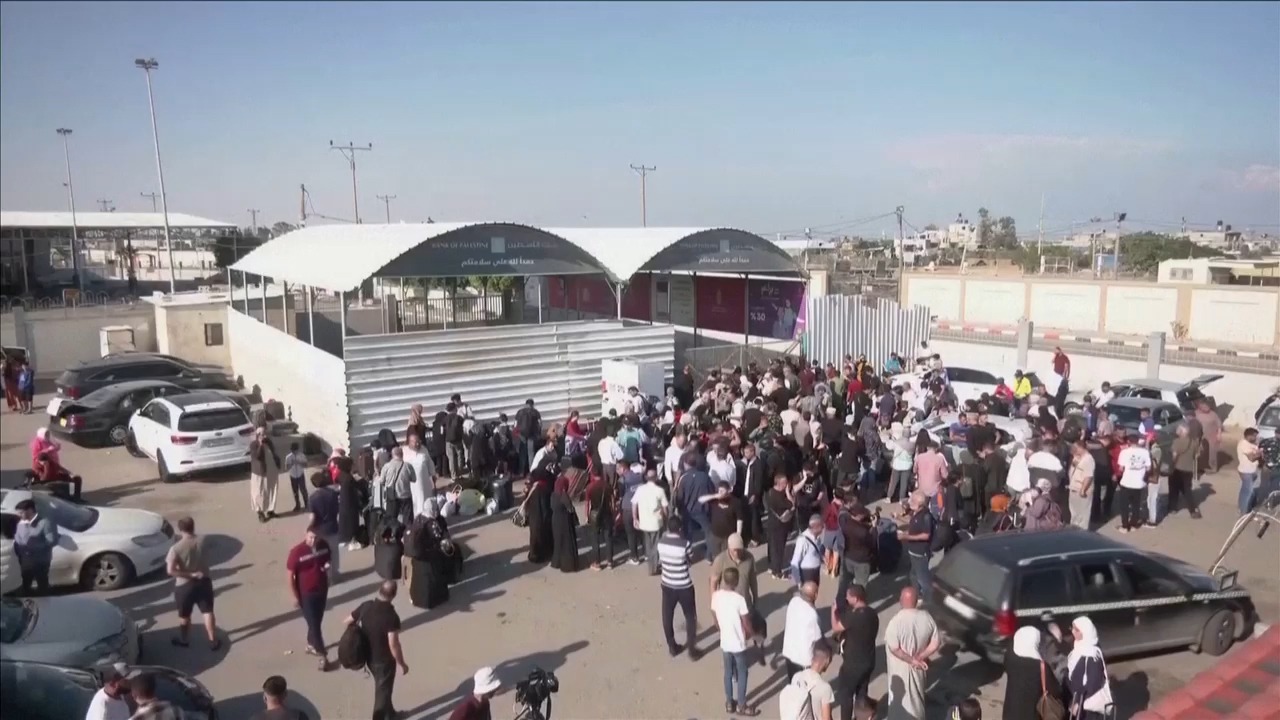
But, despite international efforts, the Rafah crossing between southern Gaza and Egypt — the prospective conduit for both refugees and humanitarian aid — has remained closed.
Some foreign officials have said Israel, which has ordered almost half of Gaza’s population to move to the south of the enclave, is prepared to let people leave the territory for Egypt, but is resisting the entry of humanitarian aid.
By contrast, Egypt has said it would allow humanitarian aid into Gaza while insisting it would only permit people with dual citizenship into its territory.
Palestinian authorities said on Tuesday that Israeli air strikes overnight had killed more than 70 people in Khan Younis, in southern Gaza, and the nearby area.
“They are still searching for people under the rubble,” said Youssef al-Aqqad, director of the European hospital in the town. “We think we will have to start making decisions as to which of the injured we should provide quick services to and which to leave.”
He added that the bombing had been very close to his hospital.
The UN said one of its schools in central Gaza had also been hit, killing at least six people, in what it said was “a flagrant disregard for the lives of civilians”.
Israel has been laying siege to Gaza in the wake of the Hamas attacks on October 7 that killed more than 1,400 Israelis, leaving the territory without mains electricity for six days and running short on water.
The Israeli military says Hamas has also taken 199 hostages, and labels a video released by the group of one of the abductees as “psychological warfare, Isis playbook material”. The video shows Mia Shem, a 21-year-old Israeli-French hostage.
Palestinian health officials say Israel’s bombardment of Gaza has killed around 3,000 people and report that more than 1,000 are missing in the rubble.
Additional reporting by Neri Zilber, Donato Paolo Mancini, Raya Jalabi and Mai Khaled
Credit: Source link