


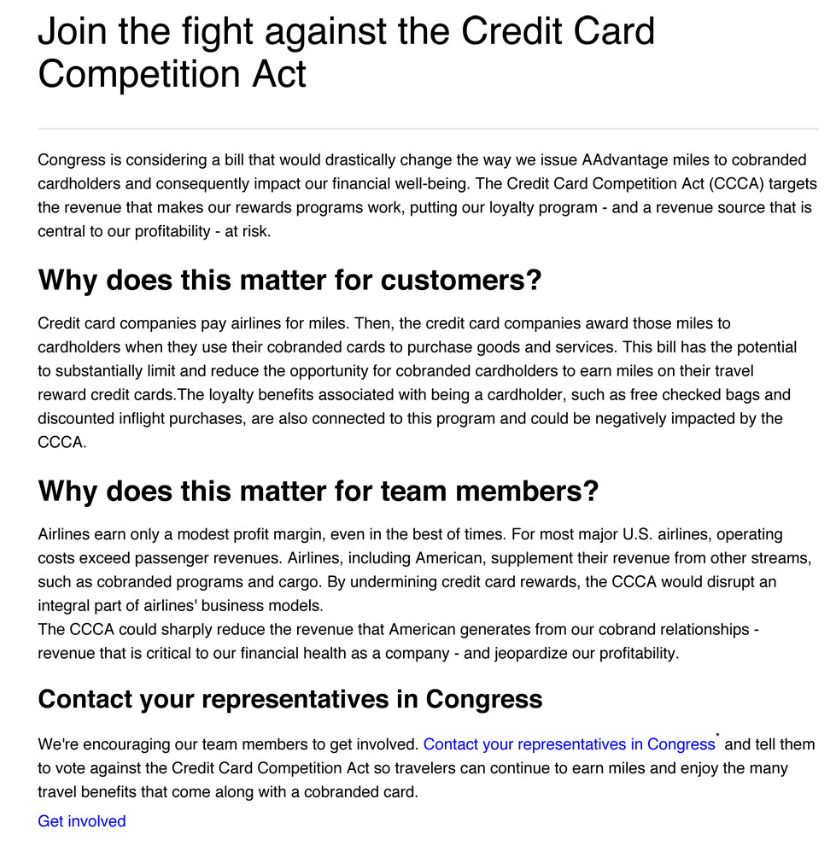
Inside the Fight: How American Airlines Is Using Its Employees To Battle Credit Card Regulations
American Airlines is asking employees to lobby against legislation from Senators Dick Durbin and Roger Marshall that would limit credit card interchange.
Nothing is going to pass this year. President Biden was the Senator from the banks Delaware and hasn’t made this a priority. Heading into an election it’s the perfect issue to fundraise on both from retailers (who would love the gift of lower card processing costs) and banks and payment networks (who see an existential threat to their business). But threats to interchange remain an ongoing existential risk.
Interestingly, American presents the (true) argument to employees that they pushed back on me over for so long – that they lose money flying planes (cost per seat mile is greater than passenger revenue per seat mile, and even passenger revenue plus cargo, in many quarters) and only turn a profit by selling miles to banks.
Rewards may seem like a side issue but it matters politically to the extent it shows how consumers are affected (and shows consumers that they are affected).
In Australia, for instance, where interchange is limited we’ve seen an increase in credit card annual fees as well as a cap on rewards earned on many cards, and limitations in the availability of credit. We’ve also seen big Qantas devaluations. Cards could still earn one mile per dollar, but each mile would be worth less (less costly to Qantas to redeem) in order to account for lower revenue per mile.
Reduced credit availability is bad for the economy overall, but it’s also bad for consumers who are forced to use their next-best available credit option – revolving balances on a credit card may be less than ideal for many, it’s also a real need if you must fix a car to get to work. Your car still needs to be fixed, and you may find yourself looking at a payday loan with far worse terms.
- The Durbin Amendment to Dodd Frank which lowered debit interchange didn’t lower consumer prices even as it lowered costs to retailers (and limited access to banking, since debit swipes used to subsidize fee-free accounts).
- And credit card interchange limits in Australia and Europe didn’t lower consumer prices there either. In fact when Australian businesses were allowed to add surcharges to credit card payments, the government then had to step in further to limit those surcharges because retailers were taking advantage of consumers!
Retailers spend a lot on payment processing, but they’re also receiving a service in exchange – the near instantaneous processing of payments from customers!
When retailer lobby shops posit that the cost of card acceptance has risen markedly since the start of the pandemic, that’s really just (1) inflation, and (2) an indicator of success – they’re generating higher revenues!
And they’re processing payments in one of the least costly ways possible. Cash is much more expensive to a retailer, given incorrect change and employee theft (not to mention counterfeiting risk). Some retailers do prefer cash of course, but one reason is that cash transactions facilitate tax fraud while card payments are far more transparent.
Ultimately credit cards aren’t just a cost to retailers, they facilitate transactions that benefit retailers, but they also benefit consumers while bundling financing and consumer protection at the same time. Interchange companies are profitable because they provide an important service, and also innovate in convenience and combating fraud. Impairing their margins – by law – to benefit the bottom lines of big merchants undercuts all of those benefits.
This is about special interests pleading for favors from the government against the public interest, though retail lobbyists mask their interest in fake consumer benefit. Obviously for American Airlines and for other big airlines, big dollars are at stake too.
More From View from the Wing
Credit: Source link