


Imagine finance as a grand opera, where not just the composed notes but also the intricate emotions define the performance. To master it, one must tune into both the mathematical rhythms and the psychological cadences.
Introduction
ADVERTISEMENT
CONTINUE READING BELOW
Traditional financial theories often present the market and its participants as perfectly rational entities operating under the assumption of maximising utility. However, years of empirical evidence scream otherwise. Market anomalies, trading volumes, and investment patterns frequently defy logical explanations, demanding a different lens – behavioral finance.
We venture into this territory to unravel some of the psychological pillars that profoundly influence financial decisions: overconfidence, regret theory, prospect theory, confirmation bias, and loss aversion.
Overconfidence: The investor’s illusion
The overconfidence bias has been the subject of extensive research. In one study, Barber and Odean (2001) demonstrated that overconfident investors traded 45% more than their less confident counterparts. This trading frequency significantly impacted their net returns, eroding them by 4.4% annually.
Overconfidence manifests more during bull markets, leading to the illusion of control. Investors often believe they can time the market, a dangerous assumption proven wrong repeatedly. The internet bubble of the late 1990s and the housing market crash in 2008 serve as glaring examples. In both cases, investor overconfidence led to speculative bubbles that eventually burst, causing widespread financial ruin.
A 2019 Fidelity survey indicated that 77% of individual investors felt they could outperform professionals. Empirical data contradicts this self-assessment – only 10% managed to surpass professional benchmarks over a decade.
Regret theory: The emotional tug-of-war
Regret theory addresses the emotional and psychological aspects that come into play when people evaluate their decisions’ outcomes. It’s not merely the money gained or lost but also the emotional satisfaction or regret associated with the choices made. Regret theory explains why people often hold on to losing investments for too long or sell winning ones too early. The fear of regret governs these decisions. This behaviour is especially prevalent among retail investors who may lack professional traders’ sophisticated tools and knowledge base.
Terrance Odean’s seminal work showed that the stocks individual investors sold underperformed the ones they bought by a whopping 3.2%, largely attributable to regret-driven decision-making.
Prospect theory: The asymmetry of gains and losses
Traditional utility theory falls short when explaining why people would decline a fair gamble. Prospect theory, developed by psychologists Daniel Kahneman and Amos Tversky, provides a framework for understanding how people evaluate potential losses and gains. Investors often display a phenomenon known as the ‘disposition effect’, where they are quick to realise gains but reluctant to realise losses. This asymmetric behaviour finds its roots in prospect theory. The investor psychology gets skewed, leading to suboptimal portfolio performance over time.
Despite the S&P 500 yielding an average annual return of about 12%, most individual investors realise a mere 2-3%. This gap is often attributed to psychological biases outlined in prospect theory.
Confirmation bias: Head or heart?
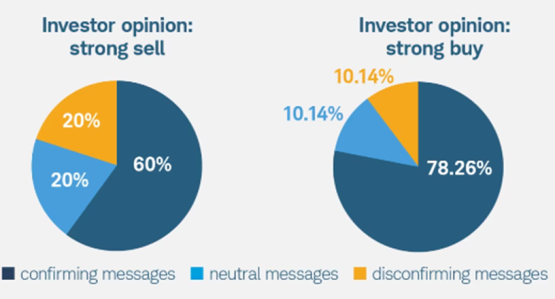
Confirmation bias is a cognitive bias that occurs when investors tend to seek and interpret information in a way that supports or confirms an existing belief, or they’ll disregard information that contradicts their beliefs. This may result in investors failing to recognise the warning signs or adequately evaluate their investment choices. Ultimately, confirmation bias leads investors to make decisions on incomplete information.
Consider the first six months of market performance in 2023. Despite widespread predictions of a recession and “hard landing” due to the Fed’s rapid hikes in interest rates, the S&P 500 index was up nearly 20% halfway through the year. By focusing on the macroeconomic information, many would have missed this surge in performance (albeit it was driven mainly by the AI mania).
ADVERTISEMENT
CONTINUE READING BELOW
A study of online stock trading message boards found that the most convincing messages confirmed investors’ pre-existing beliefs about whether or not to buy a stock.
Investors should expose themselves to all relevant information surrounding an investment and objectively assess it before deciding. Confirmation bias can also lead to other biases, such as overconfidence or loss aversion.
Loss aversion: The scale of gains and losses
Loss aversion, an offshoot of prospect theory, elucidates that the pain of a loss is psychologically twice as powerful as the pleasure of a gain. Investors, therefore, demand a higher premium for taking on additional risk. This bias explains the popularity of certain financial products like annuities or bonds, which offer lower but more secure returns.
The 2018 market volatility led to a surge in such ‘safe’ investments, substantiating the loss aversion theory. A 2017 study documented that 83% of surveyed investors preferred a guaranteed but low return over a riskier, higher potential return, emphasising the deeply ingrained loss aversion in financial decision-making.
Conclusion
It becomes clear that understanding behavioural finance isn’t just academic – it’s crucial for anyone serious about financial strategy. The human psyche is like the undertow in an ocean of logical calculation; ignore it, and you risk being swept away. Quantifying the effects of behavioural finance is complicated, as many of the different biases tend to overlap or go hand in hand. What is important is to attempt to put emotions and sentiments aside, conduct a thorough analysis of your investments, and make rational decisions.
At Paragon Wealth Managers, we use seasoned professionals who deploy a rigorously analytical approach underpinned by extensive research and due diligence. By adopting a logic-centric methodology, we aim to mitigate the risks associated with market volatility and optimise the potential for long-term capital appreciation. For further insights, visit us here.
Data sources:
- Barber, B. M., & Odean, T. (2001). “Boys will be boys: Gender, overconfidence, and common stock investment,” The Quarterly Journal of Economics, 116(1), 261-292.
- Odean, T. (1998). “Are Investors Reluctant to Realize Their Losses?” The Journal of Finance, 53(5), 1775-1798.
- Kahneman, D., & Tversky, A. (1979). “Prospect Theory: An Analysis of Decision under Risk,” Econometrica, 47(2), 263-291.
- Fidelity Survey, 2019. “Investor Insights.”
- Park, JaeHong and Konana, Prabhudev and Gu, Bin and Kumar, Alok and Raghunathan, Rajagopal, Confirmation Bias, Overconfidence, and Investment Performance: Evidence from Stock Message Boards (July 12, 2010). McCombs Research Paper Series No. IROM-07-10, Available at SSRN
- Benartzi, S., & Thaler, R. H. (1995). “Myopic Loss Aversion and the Equity Premium Puzzle,” The Quarterly Journal of Economics, 110(1), 73-92.
- Charles Schwab Asset Management
Invest wisely, for the mind can be your best ally or your worst adversary in the financial arena. Know thyself, and the investment chessboard becomes far less daunting.
Credit: Source link