



Unlock the Editor’s Digest for free
Roula Khalaf, Editor of the FT, selects her favourite stories in this weekly newsletter.
US stocks and bond prices rose on Friday after a big slowdown in hirings lifted investor expectations that interest rates have peaked.
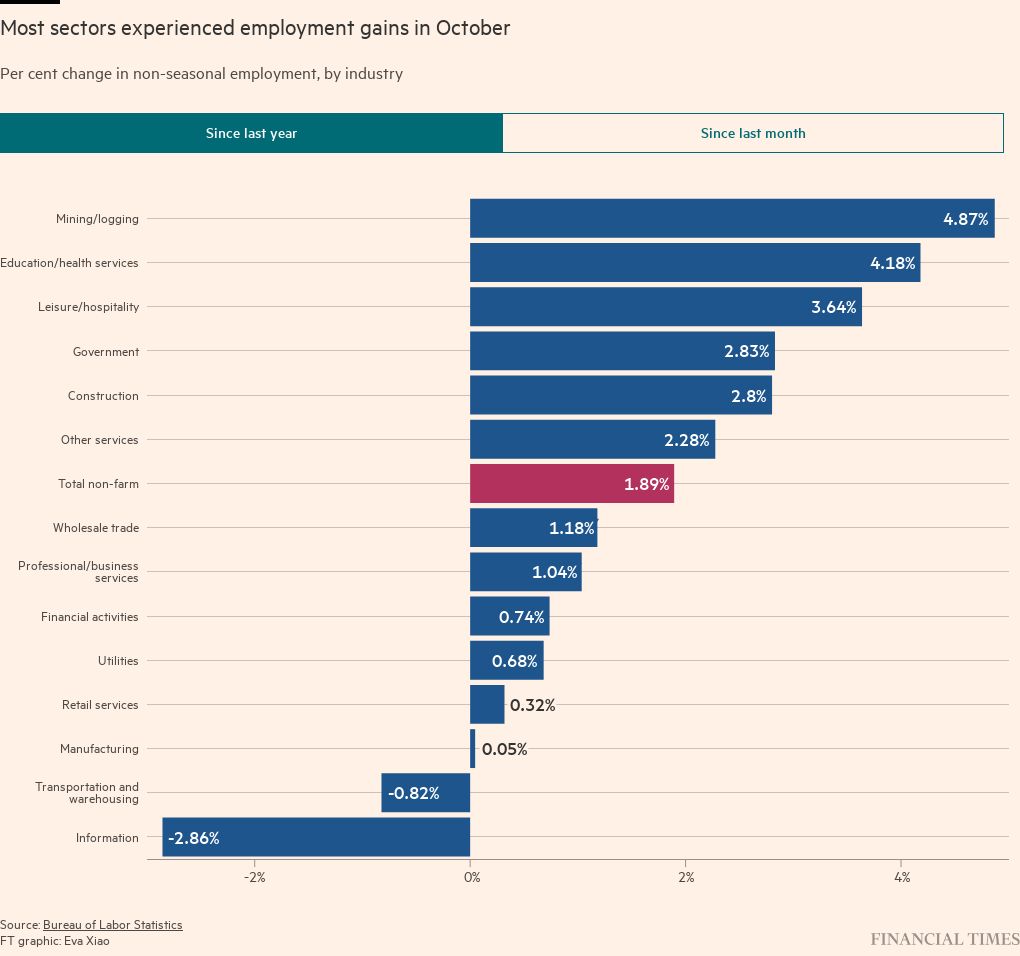
US employers created 150,000 new jobs last month — less than forecast and barely half of September’s revised figure of 297,000. Economists surveyed by Bloomberg had expected a total of 180,000 new posts for October.
The figures provided further fuel for a rally in US Treasuries, as investors bet that the slowdown in the labour market made it more likely that the US Federal Reserve will not raise rates further in coming months.
The bond market had previously strengthened this week on the back of comments by Fed chief Jay Powell that the central bank is “proceeding carefully” with future rate rises. Some investors have taken those remarks as a sign that higher borrowing costs have already slowed down the US economy.
Michael Feroli at JPMorgan said Friday’s jobs report “seemed tailor-made” to match the Fed’s message that the US was on course for a soft economic landing, as the central bank seeks to bring inflation back to its 2 per cent target. Inflation, which surpassed 9 per cent at its peak last year, is now 3.7 per cent.
Feroli added that, while some aspects of the report “hint at a harder landing to come,” including fewer industries in which employment is growing, at present, the jobs data “looks like Goldilocks”.
The S&P 500 was up 1 per cent in early-afternoon trading, putting the stock market index on track for its best week in a year. So far it has gained 5.9 per cent this week.
“This jobs report is . . . helping convince non-believers that this is very much the end of the rate hike cycle,” said Kristina Hooper, chief global markets strategist at Invesco. “We are very much in a disinflationary trend, the economy is cooling and the Fed does not have to hike rates again.”
Jobs growth is an important indicator for investors and Fed rate-setters, who monitor the labour market for evidence that the central bank’s tightening campaign is cooling the economy.
Trading in futures markets after the jobs data signalled that investors now expect an US interest-rate cut in June, compared with their previous expectations of a cut in July. Traders also pulled back further from any expectation of a further rate rise this year.
The yield on the two-year US Treasury note, which moves inversely to price and tracks rate expectations, fell to a two-month low of 4.86 per cent.
ButThomas Barkin, president of the Richmond Fed, told CNBC on Friday that it was not yet clear if interest rates had peaked, adding that the timing of potential rate cuts was “still a ways off in my mind”.
US president Joe Biden gave an upbeat response to the labour data, highlighting that unemployment had remained below 4 per cent for 21 consecutive months, the longest stretch in more than 50 years.
According to the Bureau of Labor Statistics data, the US unemployment rate rose to 3.9 per cent in October, from 3.8 per cent in September. Average earnings edged 0.2 per cent higher, a slight slowdown from the 0.3 per cent increase in the previous month.
Economists said strike action by autoworkers had probably reduced October’s headline figure for new jobs by about 30,000 — but that underlying data still indicated that hiring had slowed.
The August figure for new jobs was also revised downwards by 62,000 to 165,000.
In other figures published on Friday, the US services sector also grew more slowly than forecast last month.
After Friday’s jobs data release, the yield on the 10-year Treasury note, which moves in line with growth expectations, fell to its lowest level since mid-October, down 0.15 percentage points to 4.53 per cent.
This week’s rally has already brought about the biggest fall in 10-year Treasury yields since the US banking crisis of early March.
The Fed, which kept rates on hold on Wednesday, had previously raised them from near zero in March last year to a target range of 5.25 per cent to 5.5 per cent.
With investor confidence growing that other major central banks also appear to have finished raising interest rates, Europe’s region wide Stoxx 600 finished the week up 3.2 per cent.
In London, the FTSE 100 rose 1.7 per cent for the week, helped by a rise in interest-rate sensitive real estate stocks following the Bank of England’s decision on Thursday to leave rates unchanged.
Steve Sosnick, chief market strategist at Interactive Brokers, said that equity markets were “hyper sensitive to any whiff” that central bank policy would be less tight than previously thought.
He added that, while stock markets can react slowly to restrictive moves by central banks, they often respond quickly to a looser stance because it implies that funding will soon get cheaper.
Additional reporting by Kate Duguid and George Steer
Credit: Source link