


With its stock down 11% over the past month, it is easy to disregard Powerwell Holdings Berhad (KLSE:PWRWELL). We decided to study the company’s financials to determine if the downtrend will continue as the long-term performance of a company usually dictates market outcomes. Particularly, we will be paying attention to Powerwell Holdings Berhad’s ROE today.
ROE or return on equity is a useful tool to assess how effectively a company can generate returns on the investment it received from its shareholders. In short, ROE shows the profit each dollar generates with respect to its shareholder investments.
See our latest analysis for Powerwell Holdings Berhad
How Do You Calculate Return On Equity?
The formula for ROE is:
Return on Equity = Net Profit (from continuing operations) ÷ Shareholders’ Equity
So, based on the above formula, the ROE for Powerwell Holdings Berhad is:
8.8% = RM6.9m ÷ RM78m (Based on the trailing twelve months to June 2023).
The ‘return’ is the profit over the last twelve months. So, this means that for every MYR1 of its shareholder’s investments, the company generates a profit of MYR0.09.
What Has ROE Got To Do With Earnings Growth?
We have already established that ROE serves as an efficient profit-generating gauge for a company’s future earnings. We now need to evaluate how much profit the company reinvests or “retains” for future growth which then gives us an idea about the growth potential of the company. Generally speaking, other things being equal, firms with a high return on equity and profit retention, have a higher growth rate than firms that don’t share these attributes.
Powerwell Holdings Berhad’s Earnings Growth And 8.8% ROE
On the face of it, Powerwell Holdings Berhad’s ROE is not much to talk about. Yet, a closer study shows that the company’s ROE is similar to the industry average of 8.4%. But then again, Powerwell Holdings Berhad’s five year net income shrunk at a rate of 11%. Bear in mind, the company does have a slightly low ROE. Hence, this goes some way in explaining the shrinking earnings.
So, as a next step, we compared Powerwell Holdings Berhad’s performance against the industry and were disappointed to discover that while the company has been shrinking its earnings, the industry has been growing its earnings at a rate of 13% over the last few years.
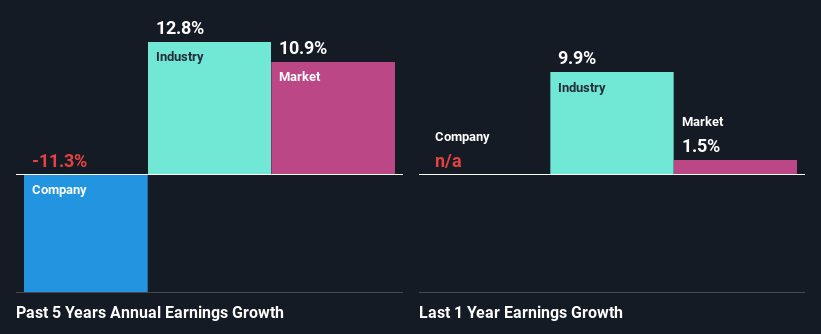
The basis for attaching value to a company is, to a great extent, tied to its earnings growth. What investors need to determine next is if the expected earnings growth, or the lack of it, is already built into the share price. Doing so will help them establish if the stock’s future looks promising or ominous. One good indicator of expected earnings growth is the P/E ratio which determines the price the market is willing to pay for a stock based on its earnings prospects. So, you may want to check if Powerwell Holdings Berhad is trading on a high P/E or a low P/E, relative to its industry.
Is Powerwell Holdings Berhad Using Its Retained Earnings Effectively?
Powerwell Holdings Berhad has a high three-year median payout ratio of 51% (that is, it is retaining 49% of its profits). This suggests that the company is paying most of its profits as dividends to its shareholders. This goes some way in explaining why its earnings have been shrinking. With only very little left to reinvest into the business, growth in earnings is far from likely. To know the 4 risks we have identified for Powerwell Holdings Berhad visit our risks dashboard for free.
Summary
Overall, we would be extremely cautious before making any decision on Powerwell Holdings Berhad. The company has seen a lack of earnings growth as a result of retaining very little profits and whatever little it does retain, is being reinvested at a very low rate of return. Up till now, we’ve only made a short study of the company’s growth data. To gain further insights into Powerwell Holdings Berhad’s past profit growth, check out this visualization of past earnings, revenue and cash flows.
Have feedback on this article? Concerned about the content? Get in touch with us directly. Alternatively, email editorial-team (at) simplywallst.com.
This article by Simply Wall St is general in nature. We provide commentary based on historical data and analyst forecasts only using an unbiased methodology and our articles are not intended to be financial advice. It does not constitute a recommendation to buy or sell any stock, and does not take account of your objectives, or your financial situation. We aim to bring you long-term focused analysis driven by fundamental data. Note that our analysis may not factor in the latest price-sensitive company announcements or qualitative material. Simply Wall St has no position in any stocks mentioned.
Credit: Source link