


Looking Ahead to 2024
We expect continued focus by the CFPB on “junk” fees,
including enforcement actions and rulemakings.
We anticipate the potential adoption of a new rule limiting the
type and amount of fees lenders can charge.
Key Trends From 2023
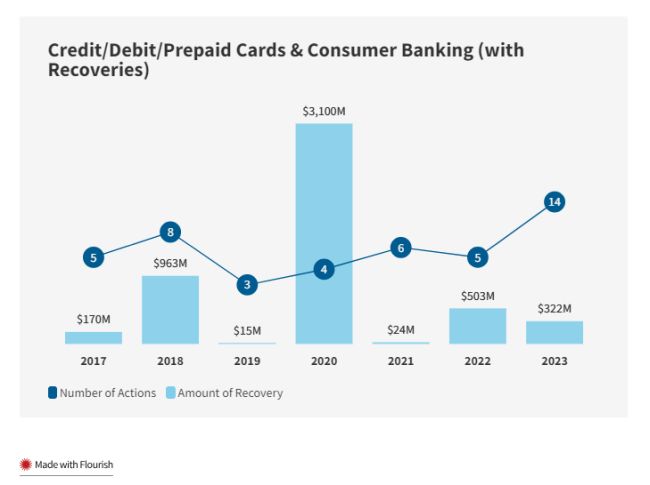
In 2023, Goodwin tracked 14 publicly announced enforcement
actions related to credit, debit, or prepaid cards or consumer
banking. Financial institutions faced enforcement actions regarding
a variety of allegations ranging from technical Regulation Z
violations to intentional ethnic discrimination. This represents an
increase in the number of publicly announced enforcement actions
from five such actions in 2022. Total recoveries amounted to more
than $322 million in 2023, a decrease from last year’s recovery
of $503 million.
In the News
Consistent with 2022, the CFPB continued its focus on “junk
fees,” a broad term the CFPB has used to describe a wide range
of fees financial institutions may charge consumers, ranging from
so-called “surprise” overdraft fees to fees charged for
basic information requests to “pay-to-play” fees. In
announcing its report analyzing “junk” fees and
interest charged to credit and debit card consumers, the CFPB
highlighted its finding that American consumers paid $130 billion
in interest and fees on their credit cards. CFPB Director Chopra
stated, “[w]ith credit card debt crossing the trillion dollar
mark, we will be working to prevent bait-and-switch tactics when it
comes to rewards and to increase refinancing activity so consumers
can get lower rates.” At the Consumer Law Scholars Conference, CFPB Deputy
Director Zixta Martinez noted that junk fees “ignore consumer
preferences, take away financial flexibility, distort markets, and
increase costs.”
On April 13, 2023, while testifying before the Pennsylvania House of
Representatives, CFPB Senior Advisor Brian Shearer stated that
the CFPB has “been using every tool at our disposal to fight
illegal junk fees, including rules, guidance, enforcement, and
supervision.” He pointed to several examples of actions the
agency has taken, including a proposed rule that would reduce credit card
late fees by $9 billion a year, a 2022 enforcement action ending with the
defendant bank paying nearly $200 million in relief for charging
its customers “surprise” overdraft fees, and the recently released report on the CFPB’s
findings of junk fees in confidential examinations.
The rule highlighted by Shearer, proposed on February 1, 2023, would limit the
amount of late fees consumers incur through three primary
provisions: (1) lowering immunity provision in the Credit Card
Accountability Responsibility and Disclosure Act of 2009, which
allows for certain late fees, to $8 for a missed payment (the CFPB has reported that some banks have charged
consumers as much as $41 for each missed payment); (2) ending the
automatic annual inflation adjustment of said fee amount; and (3)
capping late fees at 25% of the required minimum payment.
Moreover, the CFPB’s October 2023 guidance concerning
Section 1034(c) of the CFPA noted that “requiring a
consumer to pay a fee or charge to request account information,
through whichever channels the bank uses to provide information to
consumers, is likely to unreasonably impede consumers’ ability
to exercise the right granted by section 1034(c), and thus to
violate the provision.” In its guidance, the CFPB provided a
nonexhaustive list of the types of activity for which charging fees
could violate Section 1034(c): “(1) to respond to consumer
inquiries regarding their deposit account balances; (2) to respond
to consumer inquiries seeking the amount necessary to pay a loan
balance; (3) to respond to a request for a specific type of
supporting document, such as a check image or an original account
agreement; and (4) for time spent on consumer inquiries seeking
information and supporting documents regarding an account.”
This guidance is consistent with the CFPB’s growing intolerance
for fees affiliated with consumer banking accounts that Goodwin has
noted over the past two years.
2023 Enforcement Highlights
CFPB Reaches $9 Million Settlement with Bank Over
Regulation Z Allegations
In May, the CFPB announced it had reached a settlement with a
national bank to resolve allegations that the bank had violated
consumer protection laws in connection with credit card
transactions by “fail[ing] to properly manage and respond to
customers’ credit card disputes and fraud claims.” The
settlement brought an end to a 2020 lawsuit involving allegations that the
bank violated TILA (and its implementing Regulation Z) by (1)
improperly denying customer reports of fraud and errors and failing
to provide refunds, and (2) failing to provide required documents
and referrals to customers who had submitted billing errors. In
addition to paying a $9 million fee, the bank agreed to make
several changes to its credit card, including “prohibiting its
employees from requiring customers to provide a fraud affidavit
signed under penalty of perjury in support of a credit card
claim” and ensuring that it refunds any fees or other charged
amounts in response to valid billing-error notices and unauthorized
use claims.
Bank Pays Nearly $27 Million to Settle Discrimination
Claims Brought by CFPB
In November, the CFPB and a national bank entered into a consent order to resolve
allegations that the bank engaged in intentional discrimination
against Armenian Americans who had applied for credit cards with
the bank. The CFPB alleged that between 2015 and 2021, the bank
singled out credit card applicants suspected of being of Armenian
descent based on their surnames and applied more stringent criteria
to such applications, “including denying them and requiring
additional information or placing a block on the account.” The
CFPB further asserted that bank supervisors instructed employees
not to discuss the practice in writing or on recorded phone lines
and that employees were taught to lie about the reason for the
adverse actions against the applicants, typically citing suspected
credit abuse. According to the CFPB, these practices violated the
Equal Credit Opportunity Act and its implementing regulation,
Regulation B, and the Consumer Financial Protection Act (CFPA).
Pursuant to the consent order, the bank has agreed to pay $1.4
million to affected consumers as well as a $25.4 million
penalty.
CFPB and OCC Enter Into Consent Orders With Bank Over
Allegations Regarding Its Prepaid Benefit Debit
Accounts
In December, the CFPB announced it had entered into a consent order
with a national bank regarding its handling of consumers’
prepaid card unemployment benefits accounts. During the COVID-19
pandemic, the bank had contracts with at least 19 states to deliver
unemployment benefits to consumers through its prepaid card. The
CFPB accused the bank of violating the CFPA and EFTA by (1) failing
to provide consumers with accurate instructions as to how to
unfreeze their accounts when certain antifraud controls were
triggered, and (2) failing to provide provisional credits pending
the investigation of unauthorized transfers reported to the bank
under Regulation E. Under the consent order with the CFPB, the bank agreed
to pay $5.7 million in redress to consumers as well as a $15
million fine. The Office of the Comptroller of the Currency
separately fined the bank $15 million in a coordinated
investigation.
The content of this article is intended to provide a general
guide to the subject matter. Specialist advice should be sought
about your specific circumstances.
Credit: Source link